
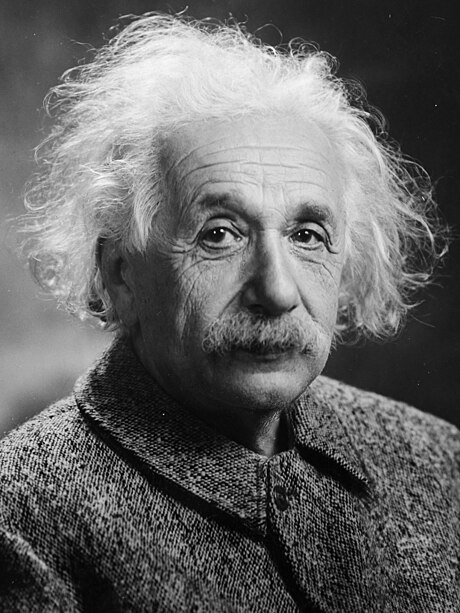
“A human being is a part of the whole called by us universe, a part limited in time and space. He experiences himself, his thoughts and feeling as something separated from the rest, a kind of optical delusion of his consciousness. This delusion is a kind of prison for us, restricting us to our personal desires and to affection for a few persons nearest to us. Our task must be to free ourselves from this prison by widening our circle of compassion to embrace all living creatures and the whole of nature in its beauty.”
― Albert Einstein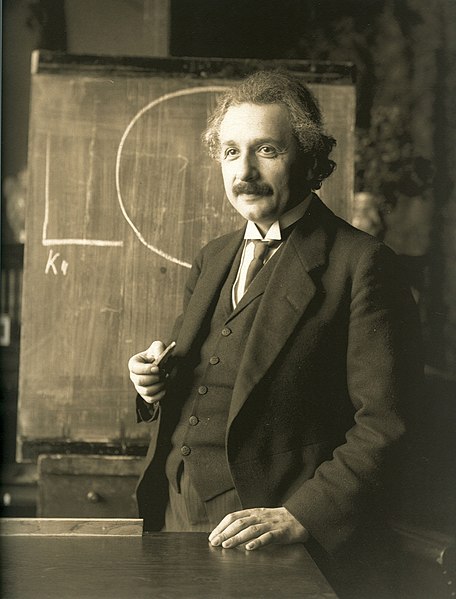
A hundred times every day I remind myself that my inner and outer life are based on the labors of other men, living and dead, and that I must exert myself in order to give in the same measure as I have received and am still receiving...
Concepts that have proven useful in ordering things easily achieve such authority over us that we forget their earthly origins and accept them as unalterable givens.
Imagination is more important than knowledge. For knowledge is limited, whereas imagination embraces the entire world, stimulating progress, giving birth to evolution. It is, strictly speaking, a real factor in scientific research.
Perfection of means and confusion of goals seem—in my opinion—to characterize our age.
When I examine myself and my methods of thought I come to the conclusion that the gift of fantasy has meant more to me than my talent for absorbing positive knowledge.
Cited as conversation between Einstein and János Plesch in János :
The Story of a Doctor (1947), by János Plesch, translated by Edward FitzGerald
- If I were not a physicist, I would probably be a musician. I often think in music. I live my daydreams in music. I see my life in terms of music. ... I cannot tell if I would have done any creative work of importance in music, but I do know that I get most joy in life out of my violin.
- Reading after a certain age diverts the mind too much from its creative pursuits. Any man who reads too much and uses his own brain too little falls into lazy habits of thinking, just as the man who spends too much time in the theater is tempted to be content with living vicariously instead of living his own life.
I'm not an atheist and I don't think I can call myself a pantheist. We are in the position of a little child entering a huge library filled with books in many different languages. The child knows someone must have written those books. It does not know how. The child dimly suspects a mysterious order in the arrangement of the books but doesn't know what it is. That, it seems to me, is the attitude of even the most intelligent human being toward God. We see a universe marvelously arranged and obeying certain laws, but only dimly understand these laws. Our limited minds cannot grasp the mysterious force that moves the constellations. I am fascinated by Spinoza's pantheism, but admire even more his contributions to modern thought because he is the first philosopher to deal with the soul and the body as one, not two separate things.
Viereck interview (1929)
What Life Means to Einstein: An Interview by George Sylvester Viereck" The Saturday Evening Post (26 October 1929) p. 17. A scan of the article is available online here.Did not appear in Saturday Evening Post story, but in Glimpses of the Great (1930) by G. S. Viereck There have been disputes on the accuracy of this quotation.
Variant, from Einstein: His Life and Universe by Walter Isaacson, p. 386:
I'm not an atheist. The problem involved is too vast for our limited minds. We are in the position of a little child entering a huge library filled with books in many languages. The child knows someone must have written these books. It does not know how. It does not understand the languages in which they are written. The child dimly suspects a mysterious order in the arrangement of the books but doesn't know what it is. That, it seems to me, is the attitude of even the most intelligent human being toward God. We see the universe marvelously arranged and obeying certain laws but only dimly understand these laws.
I am fascinated by Spinoza's pantheism, but I admire even more his contribution to modern thought because he is the first philosopher to deal with the soul and body as one, and not two separate things.
Did not appear in Saturday Evening Post story, but quoted in Einstein: His Life and Universe by Walter Isaacson, p. 387, in the section discussing Viereck's interview.
Wisehart interview (1930?)
Every man knows that in his work he does best and accomplishes most when he has attained a proficiency that enables him to work intuitively. That is, there are things which we come to know so well that we do not know how we know them. So it seems to me in matters of principle. Perhaps we live best and do things best when we are not too conscious of how and why we do them.
I do not believe in a God who maliciously or arbitrarily interferes in the personal affairs of mankind. My religion consists of an humble admiration for the vast power which manifests itself in that small part of the universe which our poor, weak minds can grasp!
Much reading after a certain age diverts the mind from its creative pursuits. Any man who reads too much and uses his own brain too little falls into lazy habits of thinking, just as the man who spends too much time in the theaters is apt to be content with living vicariously instead of living his own life.
I have only two rules which I regard as principles of conduct. The first is: Have no rules. The second is: Be independent of the opinion of others. M. K. Wisehart, A Close Look at the World's Greatest Thinker, American Magazine, June 1930.
Quotes from the interview appear on pp. 52-53 of The Twelve Powers of Man by Charles Fillmore
Source:
Albert Einstein - Wikiquote
http://en.wikiquote.org/wiki/Albert_Einstein

No comments:
Post a Comment